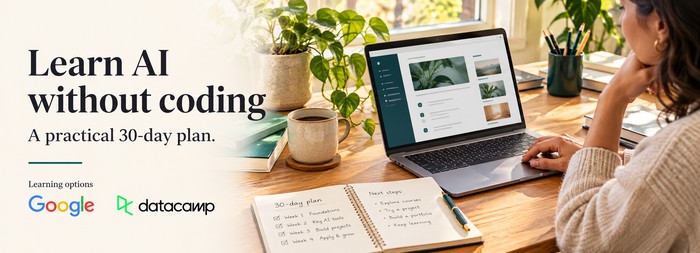
How to learn AI without coding: a 30-day plan for working professionals
Learn AI without coding through a practical 30-day plan. Choose beginner training, practise useful tasks and complete a project you can explain.
Independent AI course comparison
Build skills that fit your work, your goals
and the time you have.
Compare 108 free and paid courses. Answer six questions for a shortlist built around you.
Free to use · No account or email required
Example: new to AI, learning for work
Compare courses from leading universities and platforms
 Google
 Stanford
 Harvard
 MIT
MIT DeepLearning.AI
 Anthropic
A different starting point for everyone
Choose an example profile to see how the recommendations change.
Less searching. A clearer choice.
You do not need to know which course to look for. Start with what you want to learn.
Six questions about your role, experience, goals, study time, learning style and budget.
Compare a ranked shortlist with course details, access terms and reasons behind each match.
Go directly to the provider to check the latest details and enrol when you are ready.
Free and paid courses compete on learner fit. We earn commission on some purchases; it can only break a tie between equally fitting courses.
Make an informed choice

A practical starting point for non-technical professionals.
Read the guide →
Choose learning that helps you lead and make better decisions.
Read the guide →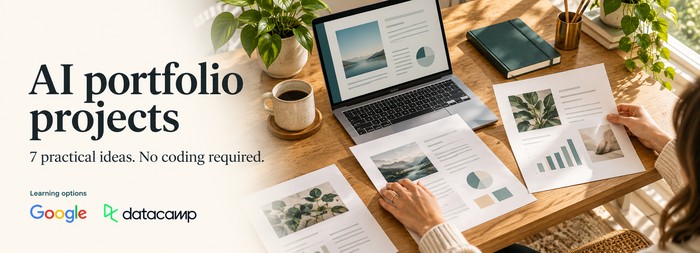
Turn your learning into useful, practical projects.
Read the guide →Your next course starts with six questions.
The full catalogue behind the quiz: free and paid AI courses, machine learning specialisations and professional certificates from Harvard, Stanford, MIT, Google, IBM, DataCamp, Coursera, Udemy and more, all comparable side by side. Take the quiz above to see which of these fits you best, or browse the catalogue by topic below.
Some links are affiliate links and are marked as such. Commission never outranks fit; it can only break ties between courses that fit you equally well.
Our story
AI Course Finder started with a simple frustration: every "best AI courses" list online was ranked by who paid the most, not by what was right for the reader. We're an independent team fixing that, matching learners to the right course by fit, never by commission.
There are thousands of AI courses now, and choosing wrongly costs real money and weeks of time. Most comparison sites are quietly optimised for affiliate payouts, burying free university courses that might be the better choice.
We score every course the same way, against six things about you: your role, level, goals, time, learning style and budget. Free courses like fast.ai and MIT OpenCourseWare rank first whenever they genuinely fit best, even though we earn nothing from them.
That independence is the whole point. The day we only recommend courses that pay us is the day we stop being useful.
Fit decides your ranking. Commission is a tiebreaker between equal fits and nothing more, and courses with no affiliate programme win those spots whenever they fit you better.
Every course is assessed against the same criteria: depth, pacing, support and outcomes, not marketing copy.
You see your full results without an account or an email. We exist to help you decide, then get out of your way.
We read everything. Whether you spotted an error or want a course added, drop us a line.
Last updated 12 October 2026
Independent coverage of the courses worth considering, who they fit, what they cost, and where cheaper or free alternatives make more sense.
Wharton is deeper and longer. Berkeley gives executives more format and price options. Here is how to choose.
Read the full guide →Learn AI without coding through a practical 30-day plan. Choose beginner training, practise useful tasks and complete a project you can explain.
Learn the AI skills managers need to select useful applications, train teams and evaluate results. Includes a practical pilot plan and course options.
Build practical Microsoft Copilot skills for documents, spreadsheets and presentations. Understand access requirements, checking methods and training options.
A practical AI learning guide for professionals in their 40s and 50s. Build on existing expertise, choose relevant training and test your next career step.
Build a non-technical AI portfolio with seven practical projects. Each includes a clear brief, quality checks and evidence you can discuss with employers.
Build a practical AI learning plan around your job. Identify changing tasks, choose relevant courses and demonstrate your skills with a workplace project.
Learn which AI skills matter for project managers, compare relevant training and build a practical project demonstrating planning and verification skills.
Explore practical AI skills for accountants, from checking financial analysis to evaluating workflows, with relevant learning resources and course options.
Understand how AI is changing marketing work, which skills to develop and how to choose relevant courses and build a credible portfolio project.
Explore how AI is changing data analysis, the skills worth strengthening and relevant courses for AI-assisted analytics or deeper machine learning.
Compare IBM’s two AI certificates by prerequisites, syllabus overlap, projects, workload and cost. Choose model-building foundations or a RAG and agents focus.
Compare IxDF AI for Designers with Adobe’s Creative Cloud Specialization: UX versus visual production, workload, membership, software costs and certificates.
Compare Stanford’s Evaluations course with the full AI in Healthcare Specialization: overlap, study scope, costs, certificates and CPD checks.
Compare AIGP certification with governance training: exam and course costs, optional preparation, maintenance and EU AI Act distinctions.
Compare IBM’s RAG and Agentic AI Certificate with the free Hugging Face Agents Course: prerequisites, costs, credentials and who should choose each.
Compare Harvard CS50 AI with Andrew Ng’s Machine Learning Specialization: programming prerequisites, difficulty, certificates and which to take first.
Wharton AI and Analytics compared with Berkeley executive AI programs for non-technical leaders: duration, price, format, depth and who each option fits best.
Compare AI courses in Melbourne in 2026 from Melbourne Business School, Monash, RMIT and the University of Melbourne, plus strong global online alternatives.
Compare corporate AI training for businesses and teams in 2026, including DataCamp, Coursera, LinkedIn Learning, Udemy Business, Microsoft Learn and executive options.
Wharton’s six-month AI leadership programme reviewed for senior executives: current fee checks, live learning, alumni status and its Coursera alternative.
Compare IBM’s 10-course RAG and Agentic AI Certificate with free and focused alternatives. Prerequisites, workload, pricing and capstone explained.
The best AI agent and agentic AI courses in 2026, compared by learner fit: Hugging Face, IBM, LangGraph, DeepLearning.AI, Udacity and Cornell, from free to executive-level.
Career Tracks are one of DataCamp’s strongest features. They are worth paying for when you want structured, interactive practice for a specific role, but a completed track should be treated as training rather than a job guarantee. The current AI Engineer, Data Engineer and Machine Learning Engineer paths are the standouts.
Compare AI courses in India by learner fit, INR fees and study format: IIT Kanpur, NPTEL, free technical courses and workplace training.
Compare online AI courses for US learners: free technical options, business training, prerequisites, certificates and USD costs.
Free, university, technical and executive AI courses compared by learner fit, cost and career goal.
Compare AI certifications by role, exam cost, preparation and renewal. Separate cloud and governance exams from course certificates and executive programmes.
Compare regulation, governance, compliance and AI literacy training for legal, technical, public-sector and business roles.
Compare Stanford’s five-course AI in Healthcare Specialization by learning scope, evaluation-course overlap, workload and current access terms.
Stanford’s healthcare AI evaluation course assessed by published curriculum, learner fit, programme overlap and certificate access.
Compare Hugging Face’s free Agents and LLM courses: Python prerequisites, certificates, learner fit and alternatives to paid AI training.
The best AI safety, policy and governance courses in 2026, ranked by our engine from a thirteen course shelf: what each covers, who it suits, and how to sequence them.
Compare AI courses in Australia for beginners, business professionals and developers, with AUD fees, prerequisites and university qualification distinctions.
Is Harvard’s CS50 AI right for you? Compare Python prerequisites, project workload, free and paid certificates, and alternatives for beginners.
Skip the reading
Answer six quick questions and we'll rank all 108 courses by your role, level and budget, not by who pays us.
Match me to the right course →Google AI Essentials assessed by syllabus, learner fit and regional subscription cost. US$49 is a monthly US and Canada reference price.
Eden Marco’s LangChain and LangGraph course assessed by curriculum, Python prerequisites, study time, variable pricing and free alternatives.
The best genuinely free AI courses for designers, illustrators and creative professionals in 2026: what each actually teaches, and where free stops being enough.
DataCamp’s two-hour AI primer assessed by published scope, learner fit, free first-chapter access and paid plan terms.
Compare DataCamp’s current AI and data learning paths by goal, syllabus, free chapter access, subscriptions and practical learning evidence.
 Review
We put DataCamp's two-hour Understanding Artificial Intelligence primer against its AI and data learning paths to see who should start where, and why.
Two completely different models for learning AI. We compared them using real courses from our own catalogue, not just brand reputation.
We looked at whether the all-access subscription actually pays off for AI and data learners specifically, not just the general cost maths.
IxDF AI for Designers assessed by published scope, 14.5-hour workload, weekly lesson release, membership terms and learner fit.
Adobe’s three-course Specialization assessed by published design scope, software access, learner fit and regional price checks.
Free courses from Harvard, Google and OpenAI teach real skills. Paid certificates can teach useful skills too. The difference isn't quality, it's what you actually need out of the course.
The best AI courses for doctors, nurses and allied health professionals in 2026, ranked by our matching engine. Stanford Medicine, Health AI CPD and more, compared honestly.
The best AI courses for government, policy, non-profit and academic professionals in 2026, ranked by our matching engine. Stanford, Harvard, fast.ai and DeepLearning.AI compared honestly.
The best AI courses for designers, illustrators, video and UX professionals in 2026, ranked by our matching engine. Adobe, IxDF and LinkedIn Learning compared honestly.
The best AI courses for developers and engineers in 2026, ranked by our matching engine. Hugging Face, LangChain, MCP, Llama, Stanford and fast.ai compared honestly.
The best AI and machine learning courses for data analysts and BI professionals in 2026, ranked by our matching engine. Stanford, Harvard, IBM, Google and DataCamp compared honestly.
The best AI courses for marketing, growth and content roles in 2026, ranked by our matching engine. IBM, Emory, Learn Prompting, Google and more, compared honestly.
The best AI courses for managers, strategists and business leaders in 2026, ranked by our matching engine. Wharton, LinkedIn Learning, DeepLearning.AI and more, compared honestly.
A dedicated generative AI course and a career prep course have been added to the curriculum. Here's what's actually different, and who should care.
The certificate has grown from a deep learning fundamentals course into a 13-course series covering fine-tuning, RAG, and building AI agents. We look at what's changed and who it's for.
 Guide
GuideAn AI course finder matches you to an AI or machine learning course based on your background, budget, and goals. Here's how they work and what to look for.
Most people pick an AI course backwards, by name recognition, then hope it fits. Here's the six things worth figuring out about yourself first.
A new free learning hub aimed at non-technical professionals. We break down what's actually covered and who it's for.
One is free and code-first, the other structured and credentialed. We mapped both against four learner types.
Google AI Professional Certificate includes an app-building capstone. It is a separate programme from AI Essentials, so compare their scope before choosing.
From MIT OpenCourseWare to Karpathy's Zero to Hero, the free courses that genuinely rival paid ones.
Coursera's pricing has more layers than it looks. We crunch whether the all-access subscription still beats paying per course.
IBM AI Engineering assessed by its current thirteen-course curriculum, preparation, projects and regional access terms.
An editorial assessment of Andrew Ng’s Machine Learning Specialization based on the published curriculum, prerequisites and learner fit.
No posts in this category yet, check back soon.
New reviews, course news and price drops, published as we find them.
Email alerts are not running yet. In the meantime, browse our latest reviews or email hello@aicoursefinder.com.au to suggest a course for the catalogue.